The arm lines are the myofascial meridians that connect the hands and arms to the shoulders, spine, and core through an interconnected fascial network. Understanding and engaging these myofascial meridians in Pilates can improve posture, shoulder stability, movement efficiency, and whole-body integration by helping you move from your center outward.
Have you ever been told to “move your arms from your back” while on the mat or using an apparatus? If so, then you’ve already been introduced to the concept of the arm lines.
As first described in Thomas Myers’s Anatomy Trains, the arm lines are the myofascial meridians that connect the hands and arms to the shoulders, rib cage, spine, and ultimately, the center of the body. Learning about the meridians encourages you to think about your upper body as a connected network of muscles and fascia that work together to create efficient, powerful movement.
As a Pilates practitioner, you can use the arm lines to transform the way you approach arm work, shoulder stability, posture, and engaging your core.
Meet the Arm Lines
In Anatomy Trains, Myers identifies four primary arm lines: the superficial front arm line, the deep front arm line, the superficial back arm line, and the deep back arm line. Together, these lines connect your hands to your torso, creating a bridge between your extremities and your core.
The arm lines show up in your Pilates practice as well as everyday life. Whenever you reach, push, pull, lift, carry groceries, or perform a movement on an apparatus or on the mat, these connections distribute force throughout your body so a single joint or muscle group doesn’t bear the full brunt of the load.
Why Arm Lines Matter in Pilates
When you incorporate the Pilates principle of centering into your practice, you focus on originating every movement from your core and radiate it outward through the limbs. Add on activating your arm lines, and it is common to experience:
- Efficient movement from core to hand.
- Improved shoulder stability.
- Less unnecessary tension in the neck.
- Power that generates from the core, not the shoulders.
- Improved posture.
- Connection between the arms and the core for whole-body movement.
On the other hand, when you don’t take the arm lines into account, you may notice:
- Rounded shoulders.
- Neck tension.
- Shoulder impingement.
- Difficulty stabilizing during arm movements.
- Overuse of wrists and hands.
- Disconnected movement patterns.
In your Pilates practice, if you’ve ever been cued to engage your back muscles, connect your shoulder blades, or move from the center rather than from your arms, then you’ve already experienced how the arm lines can be incorporated into your Pilates movements.
Let’s take a look at each of the four primary arm lines.
The Superficial Front Arm Line
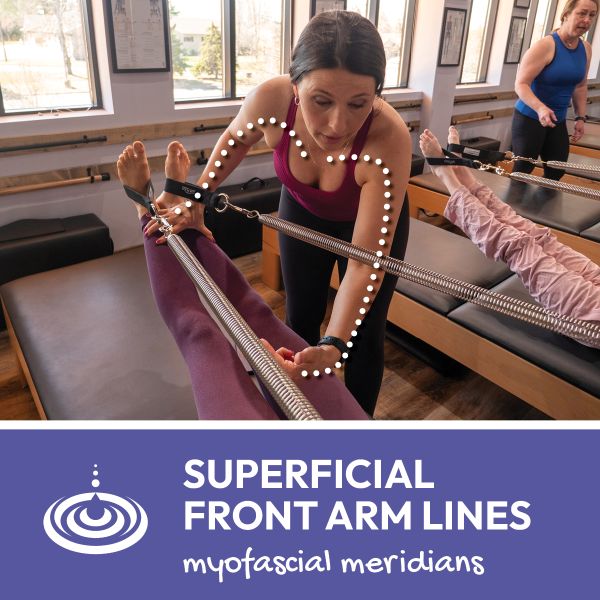
The superficial front arm line (SFAL) runs along the front of your arms. It is heavily involved in reaching, hugging, pushing, and bringing the arms forward, as when you open a heavy door, push a shopping cart, or reach forward to grab something.
In Pilates, your activate your SFAL in movements such as chest expansion, hug-a-tree, arm circles, push-through bar work, and plank variations. When activated, your SFAL creates strength and support without collapsing your chest or rounding your shoulders.
The Deep Front Arm Line
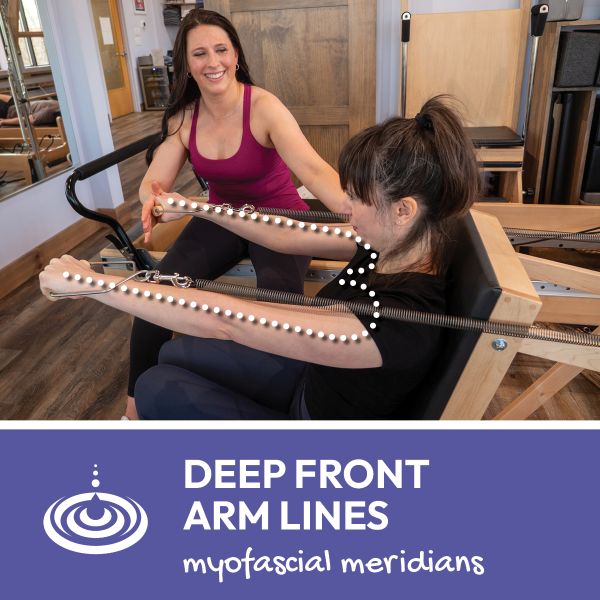
The deep front arm line (DFAL) connects your arm to the deeper stabilizing muscles and fascia in your torso. It plays a critical role in shoulder stability and fine motor control.
In Pilates, we activate the DFAL in movements such as the long stretch series, weight-bearing exercises, side plank variations, arm work on the Reformer, and stability-focused movements.
The Superficial Back Arm Line
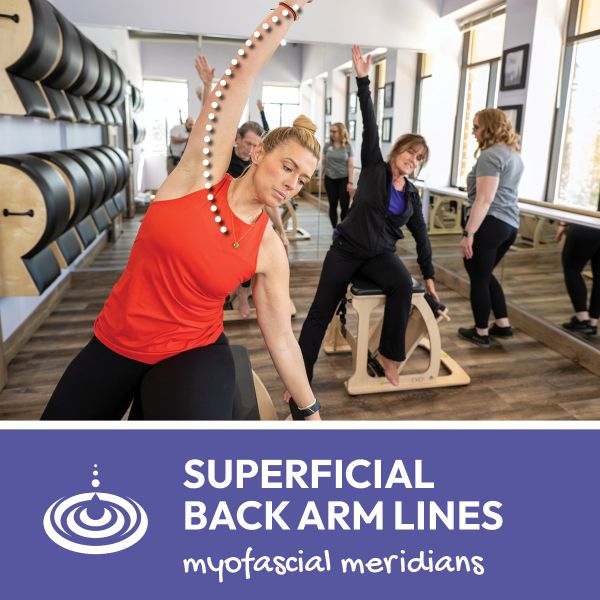
The superficial back arm line (SBAL) travels along the back of your arm and connects to your upper back and shoulder girdle. The SBAL is responsible for pulling actions and arm extension.
In Pilates, your SBAL is activated in several movements, including rowing exercises, pulling straps, swan, breaststroke, and chest expansion.
The Deep Back Arm Line
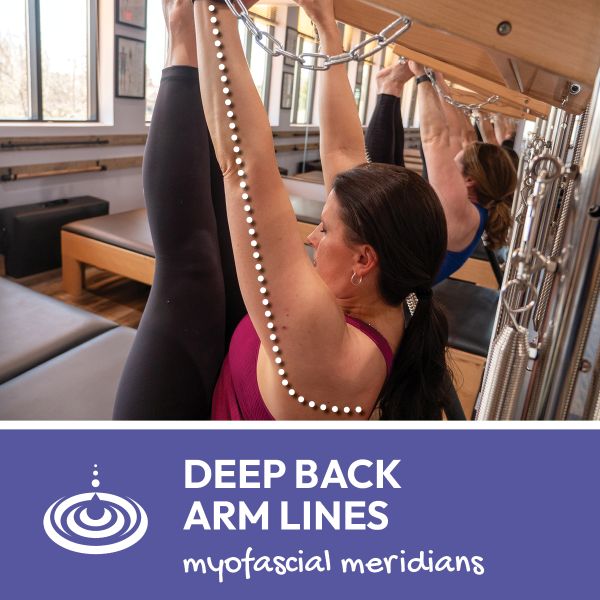
Finally, the deep back arm line (DBAL) provides deeper support to your shoulders and connects your arm to your spine through stabilizing muscles. It contributes to precision, control, and efficient transfer of force through your upper body.
In Pilates, the DBAL gets activated in movements during advanced plank work, push-up variations, rotational exercises, weight-bearing sequences, and long box exercises.
Incorporating Arm Lines in Your Pilates Practice
Noticing the arm lines and incorporating them into your Pilates practice is easy. Here are a few ways you can start.
Connect Your Arms to Your Back
Instead of lifting from your hand, initiate movement from the muscles around your shoulder blades and rib cage. This creates a stronger connection between your arms and your center.
Maintain Shoulder Stability
Let your shoulder blades move naturally, with no shrugging or gripping in your neck. Stable shoulders are the foundation for arm movements.
Move from Your Center
Pilates works best from the inside out. Before moving your arms, establish support through your breath, core, and spine. Then, allow that support to travel outward through your arms.
Use Breath to Enhance Connection
Using your breath helps you organize movement through your rib cage, shoulder girdle, and core. A well-timed exhale can help deepen support through your trunk and create more efficient arm movements.
When you understand arm lines and notice them in your Pilates practice, arm exercises become full-body movements that integrate strength, stability, and coordination. The next time you’re on the mat at JLB Pilates, pay attention to how your arms connect back to your center. You may discover greater ease, improved posture, and a stronger sense of how your body is connected.
At JLB Pilates, we incorporate the arm lines and the other myofascial meridians into our classes and private sessions to help you get the most out of your Pilates journey. Schedule a tour of JLB Pilates today to see the studio and complete our initial assessment. Visit our website today to get started.
Arm Lines in Pilates FAQs
What are the arm lines in Anatomy Trains?
The arm lines are four myofascial meridians (the superficial front arm line, deep front arm line, superficial back arm line, and deep back arm line) that connect the arms and hands to the rest of the body through fascia and muscle.
How do the arm lines relate to Pilates?
Pilates emphasizes moving from the center of the body outward, and the arm lines help create that connection by linking arm movement to the core, spine, and shoulder girdle for more efficient and controlled motion.
Why are the arm lines important for shoulder health?
When the arm lines are balanced and functioning well, they help distribute forces throughout the body, improve shoulder stability, reduce neck tension, and minimize compensatory movement patterns that can lead to discomfort or injury.
How can I incorporate the arm lines into my Pilates practice?
Focus on initiating movement from your core and upper back, maintaining shoulder stability, coordinating breath with movement, and viewing arm exercises as full-body movements rather than isolated upper-body work.