The deep front line (DFL) is a continuous myofascial meridian that connects key deep structures including the arch of the foot, inner thighs, psoas, pelvic floor, diaphragm, heart fascia and deep flexors in the neck into one integrated system. By understanding how the DFL applies to Pilates principles, you can unlock movement that feels more effortless and more deeply supported.
Did you know that beneath the surface of your skin, an extraordinary web of connective tissue quietly governs your breath, posture, and movement? Coined collectively by anatomy and movement educator Thomas Myers in his book Anatomy Trains as the myofascial meridians, this web of connective tissue is invisible to you, but it is a major factor in how your body moves through the world.
In his book, Myers identifies twelve myofascial meridians that run through the body, transmitting force and organizing your posture. Let’s take a closer look at your deep front line (DFL), the meridian that runs through your body’s core from feet to skull.
The Deep Front Line
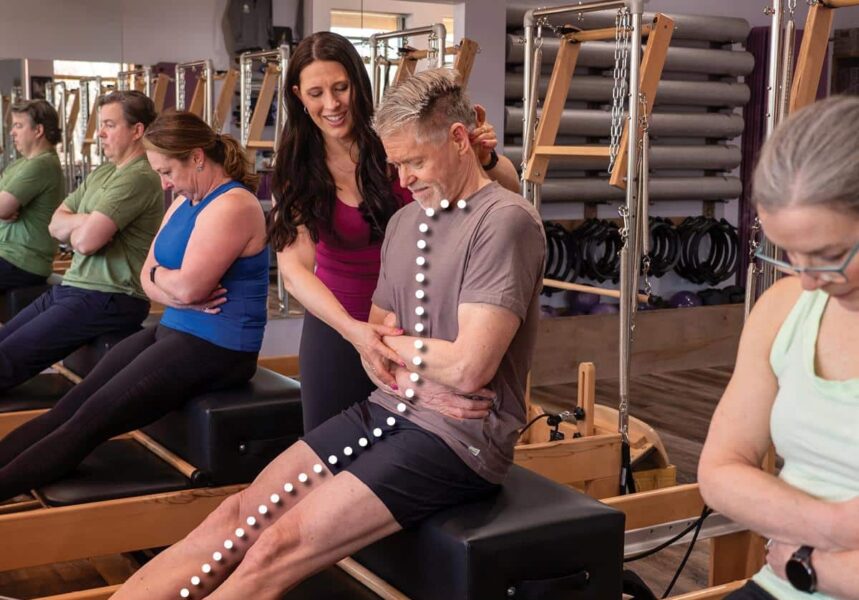
The deep front line (DFL) runs from the soles of your feet, through your inner legs, pelvic floor, psoas, diaphragm, heart fascia, deep neck muscles, all the way to the base of your skull. It’s your body’s deepest layer of functional support and is responsible for holding your body upright.
Studying the myofascial meridians teaches us that these structures do not act in isolation. When tension or restriction enters your body anywhere along this meridian, it can affect your range of motion and comfort in other structures along the meridian. For example, a tight hip flexor may cause pulling on your neck.
The DFL and Pilates
Joseph Pilates formed his entire method around what he called the powerhouse, or the deep abdominal, pelvic, and spinal muscles. All of these muscles are found along your deep front line. When we work one muscle along the meridian, it activates the entire DFL.
Let’s take a look at how you can feel your DFL when you’re on the mat or working on the Reformer.
Noticing DFL on the Mat
Several movements help you feel your DFL on the mat. Lie in constructive rest with a block between your knees. On your inhale, soften the pelvic floor, and on the exhale, gently lift from the base and sense the adductors engage. This awakens the DFL from the pelvis downward.
Rather than pulling from the neck or bracing the belly, initiate a roll-up by lengthening the psoas or opening the front of the hips away from the lumbar spine and engage your seat. This keeps the DFL long and articulate rather than shortened and gripped.
Noticing DFL on the Reformer
You can feel your DFL while working on the Reformer, too. In standard footwork, press through the inner heel and lift the inner arch. Notice how this quietly activates the deep inner thigh and connects upward into the pelvic floor. Avoid gripping the toes. Or, in plank-based work, gently nod to drop the chin, activating the deep neck flexors and engaging the DFL through its upper end.
4 Principles of a DFL-Informed Pilates Practice
To create a more DFL-informed Pilates practice, we recommend incorporating these four principles.
- Start from the Ground Up: Ground the arch of your foot and inner ankle before cueing the core.
- Lift, Don’t Brace: Bracing your abdominals can compress the DFL. Instead, try a gentle scoop of the pelvic floor lift and lower abdominals, then activate your inner thigh muscles by drawing your heels together.
- Breathe Through the Line: Your diaphragm is at the heart of the DFL, making breath an important factor in activating your deep front line.
- Length Over Compression: The DFL thrives on decompression, so focus your practice on lengthening by imagining space between each vertebra or through each joint.
Putting It All Together
Incorporating the DFL into your Pilates practices is less about adding new moves and more about shifting your attention from your outer movements to the inner architecture of your body that supports movement. We’ve found that when clients learn to sense and lengthen their deep front lines, they discover a quality of movement that feels more supported while taking less effort to achieve. That is when your Pilates practice becomes truly transformative.
At JLB Pilates, we incorporate the DFL and the eleven other myofascial meridians into our classes and private sessions to help you get the most out of your Pilates journey. Schedule a tour of JLB Pilates today to see the studio and complete our initial assessment. Visit our website today to get started.
Deep Front Line FAQs
Do I need to understand fascia to benefit from DFL-informed Pilates?
Not at all. While a basic understanding of the fascial system enriches your practice, the cues themselves are accessible to any student. Lifting from the pelvic floor, grounding through the inner heel, and breathing three-dimensionally are all cues you can incorporate into your practice today.
Is the deep front line the same as “the core”?
It overlaps significantly, but it’s broader. The DFL includes structures like the inner arch of the foot, the adductors, and the deep neck flexors that most core-training frameworks ignore. Think of the DFL as the full vertical spine of the body’s deep system, not just the abdominal core.
Can working with the DFL help with chronic back pain?
Restrictions along the DFL are frequently associated with lumbar tension and poor spinal loading. Addressing the whole line, rather than isolating the low back, can be a more effective and lasting approach, though anyone with chronic pain should work alongside a qualified healthcare professional.
How are myofascial meridians different from standard Pilates?
Standard Pilates already activates much of the DFL. The difference is in intention and imagery. DFL-informed Pilates cues length and inner lift rather than bracing and pulling in, and it traces connections to the full length of the body rather than addressing segments in isolation. It’s less a departure from Pilates and more a deeper anatomical lens on what a good Pilates practice already does.